Custom Hero Survival: 122 Abilities, a Ledger and a Tavern
In Custom Hero Survival you do not pick a ready-made hero. You pick a body, buy abilities with lumber in eleven shops, raise each one to level 20 and build the hero you want, while surviving level after level of creeps in your arena. Between levels there is a 30-second break to shop, and at the end, PvP rounds with bets, a Battle Royal and Elimination. The reference is the map Custom Hero Survival Z2.6 M9.8.17, and the game's first phase, CLASSIC, is the map as it is, with its rules, numbers and quirks, before any modernisation.
A ledger
The method here is stricter than in the other games. Reproducible extractors read the map and produce tables with evidence: every rule points at the script line it came from. The fidelity ledger is the reconstruction's source of truth, line by line, revised against the code at every stage, and a content matrix generated from the code says what is covered. A parity report separates, bluntly, what is 1:1, what is equivalent and what still diverges.
Fifteen days
On October 10, the first day, came the playable vertical slice: three representative heroes, the full custom ability system, the ability and item shops, level and experience, gold and lumber, the first wave, the break, the second wave, and death without respawn, as in the map (the Ankh reincarnates once). The same day, PvP rounds and bets, the Battle Royal, Elimination and item crafting. Then the ability bases in series: the actives (area spells, channels, summons), the passives, the auras, the attack modifiers and the buffs; every hero's specials across the roster; the item abilities; and the map's chat commands, from -ms to -kick, with vote-kick and periodic hints. For that the engine gained what it lacked: casting time, corpses, per-unit attack cooldown, percentage damage, damage types and illusions. The learn system was ported from the map's pickup triggers, with Random Ability, and the companions, the Faerie Dragon and the Wisps, come back, follow and heal. By the end of the first week: 120 of the 122 abilities and 763 tests.

On October 24, an ability audit and an item audit closed what was left: crafted items work, dummy kills pay income, and the last bases came in, Phoenix Fire, the invulnerability potion, the orbs, Slow Poison, Feedback, Spell Shield, Glyph of War, dispel and bouncing attacks. 122 of 122. Whole matches with bots in eleven scenarios run twice with the same seed to prove determinism (one revealed an endless rebirth loop in a lethal duel, since fixed), and the network checksum now covers the learn state, inventories, ability levels and the shops' stock. Today there are 1,085 tests.
What the map did not have
With CLASSIC standing, MODERN began: a ruleset chosen in the lobby. The shop was redesigned after a UX, controller and lockstep review: three styles (panel, merchant, anywhere), buy five at once, repeat the last purchase, and builds with quick buy after Dota 2 and LoL. The hero pick screen is Dota's "choose your hero" over the map's pick board. Heroes have a team ring, a faint halo and their name; in the Dota layout the inventory sits in the command card.
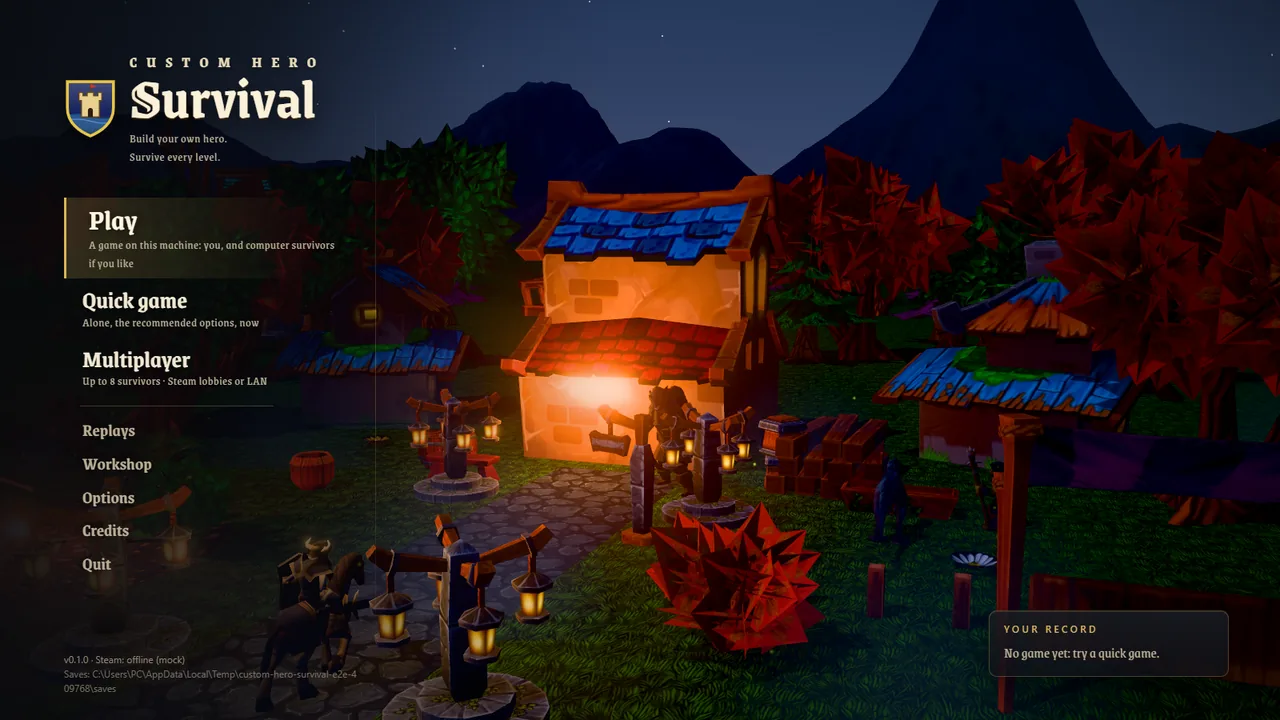
The visuals followed: icons from the bought packs for every ability, item and hero and for the HUD, an effect and a sound per ability, sword slashes on melee hits, the engine's ki auras and ultimates on the big spells, units facing where they shoot, and hero bodies in the art's own skins. Behind the menus there is a tavern, every hero inside, filmed in nine shots.
And the infrastructure: continuous integration, a Windows installer and portable build, rejoin from a checkpoint of the world, a script that opens a LAN game with a person, and the game's data going to and from Kastle Studio, hero bodies included.
— The team