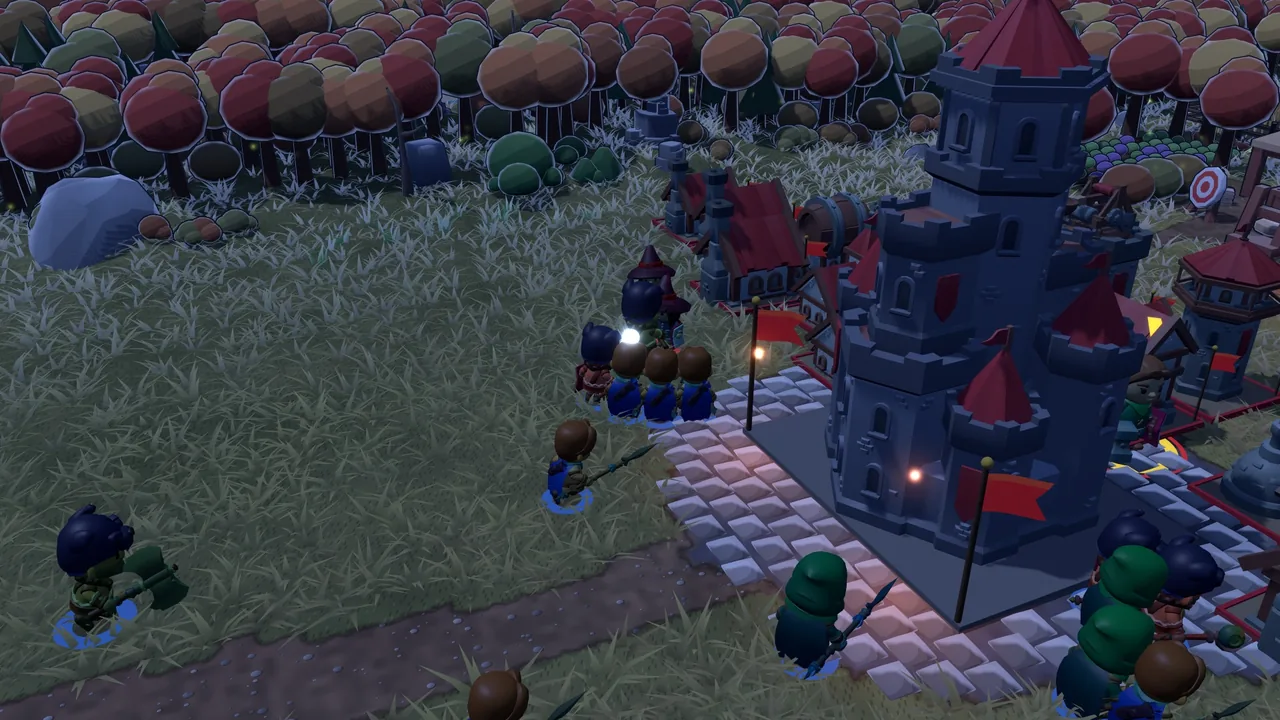

Line Tower: the Maze That Gave Birth to the Engine
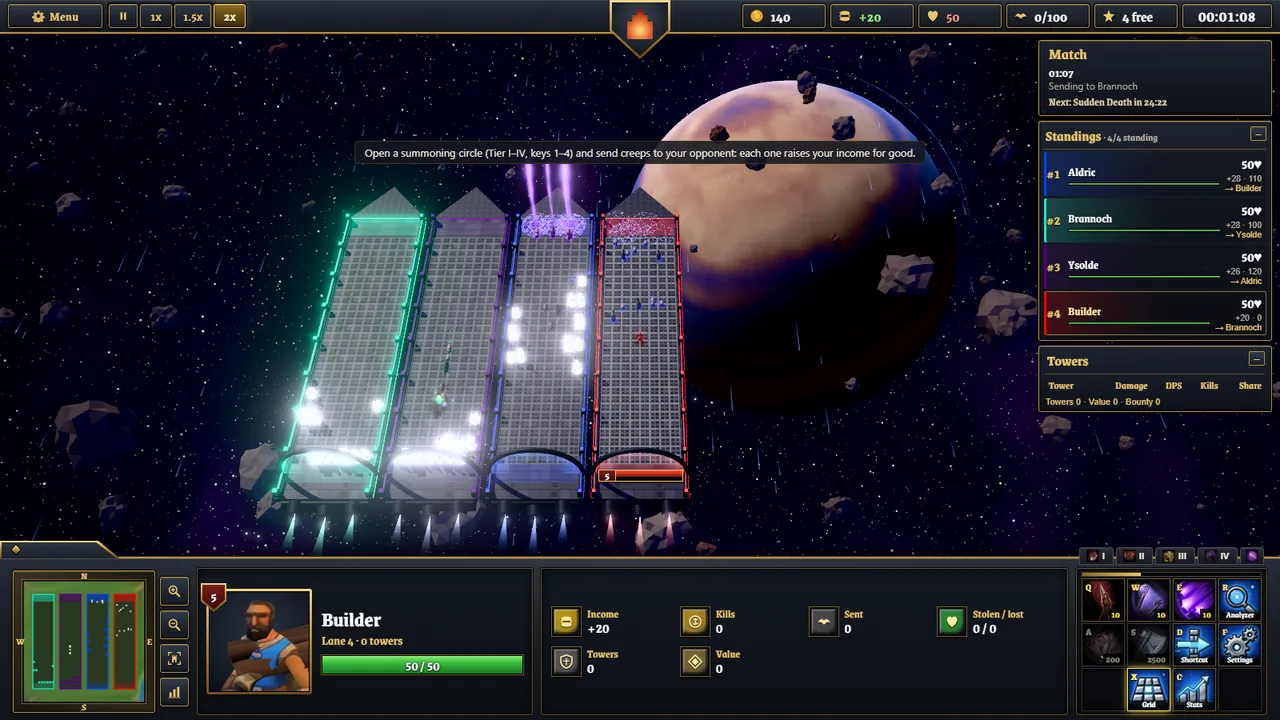
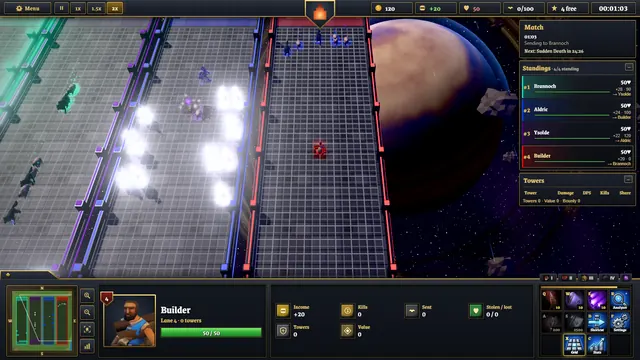
Line Tower Wars is one of the most played Warcraft III maps, and the rule is simple to state: every builder holds a lane, mazes it with towers so the creeps take longer to cross, and sends creeps into the next builder's lane. Every send raises your income for good. Whoever lets creeps through loses lives. Up to twelve builders, online through Steam or against computer players.
Reading a protected map
The reference is Line Tower Wars: Reforged 12.1b. The map's script is 34,580 lines long and protected: scrambled names, regions and units created in code, texts hidden inside ability tooltips. The work of October 9 was to rebuild that string table, annotate the script line by line and cross it with the object data, separating what the map sets from the game's stock values. Where the code contradicts its own tooltip, Line Tower follows the tooltip. The content is generated straight from the map's data, and a document says, line by line, what matches and what does not yet.
From the map came the lanes and the maze, the builder, the shops and their stock, the sends, the income, lives and recycling, research and Start Tech, every tower and creep trait, the Technology Discs, the modifiers, the computer players, rating and skins. The map is treated as untrusted data: copied into an empty folder and read by extractors that never execute anything from it.
The day the engine was born
Line Tower was the third game to start in a week, and the first not to start from scratch. The core of Castle Survivors, everything that was not one of its rules, moved to a package of its own the same day: Kastle. Line Tower is "the engine plus a game folder", with its manifest, simulation, content, lockstep session and screens. The engine never imports the game, and an automatic check guarantees it. What Kastle is, and what it became over the next two weeks, is in its own post.

What already plays
In a few days Line Tower gained what a game needs to be played: replays and desync reports, a deep space map with lane thumbnails for every map, four maps with nebula skies, a random map, and sheep running the gauntlet behind the menus. A quick tutorial of eight guided steps in a sandbox. Shots per weapon, creep factions and soundscapes per map. The hologram build ghost, range rings and a grid drawn by shader, the builder striking with a pickaxe while a tower goes up, cannons with ballistic aim and barrels that aim by distance, effects for building, upgrading and selling, and what each button undoes. Weapon recipes with element variants and positional sound, art on the command card and the utility buttons, and creature animation on the GPU.
The network was tested deep: an end-to-end test with two LAN instances that drops and reconnects a player, and harder soak scenarios. The game has a Linux build for Steam and the Steam Deck, with a Deck guide, and plays entirely on a controller: the D-pad walks the summoning circles, Y researches, View goes home.
On the 24th and 25th Line Tower exported its data to Kastle Studio, started taking back what is edited there, adopted the engine's new round (a rejoin that carries in-flight commands, checksums by part, the determinism lint), and gained the one-command Steam test build.
What is still provisional
Line Tower's names, art, sounds and texts are our own, but provisional. The game's own universe is the next step.
— The team