Two Hard Problems
Two problems took far more measuring than we expected: melee troops that would not fight, and troops that fly.
The soldier walking in place
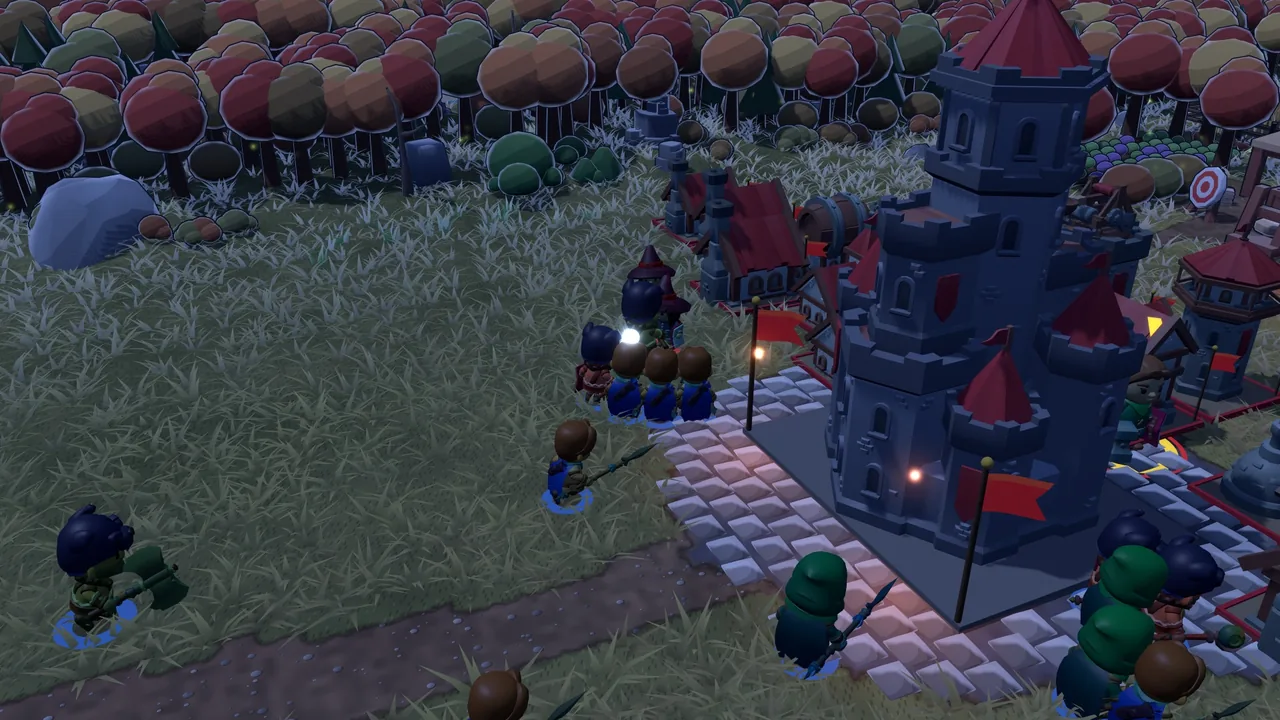
When two armies met, the melee troops at the back would press against their allies' backs and walk in place, legs moving, going nowhere. Each one headed straight for the nearest enemy, usually the same enemy the soldier in front was already fighting, and the rule that keeps troops from overlapping pushed it back every step.
We measured it before changing anything. In melee fights on open ground, troops spent 26% of their combat time walking in place. In a narrow corridor it was 35%, and in ordinary matches between computer players, 9.7%.
To find a fix, we built a lab: a copy of the simulation where only the movement rule can be swapped. It staged four scenarios (open ground, a mixed army with archers, a corridor about four troops wide, and a skeleton swarm) plus full matches. A troop counted as walking in place if it walked for half a second but covered less than a quarter of the distance its speed allows. Then we tried 13 different rules.
The failures taught us a lot. "Stop if an ally is fighting in front of you" eliminated walking in place, but fights took twice as long, because nobody from the back ever arrived. Aiming for a free spot around the target barely helped: in a battle line, that ring is already full of the enemy's own neighbors. What worked was picking a target that has a free attack spot, then finding a path to it around whoever is standing still.
The winner is the patient route: a troop plans a short path to the nearest free attack position, tries to squeeze between allies, and if it gets stuck, re-plans without squeezing or waits. Walking in place fell to 5.6% in the open, 6.8% in the corridor and 1.3% in full matches. One rival rule did even better in matches (1.0%), but in the corridor its troops stood in a tidy queue and landed fewer hits than before. The patient route pushes through first, and it simply looked more natural.
Did it break the balance?
Any of these rules makes melee much stronger: with the same troops on both sides and the new rule on one side only, it won 79–100% of the fights. One Training lesson broke on the spot, with its all-melee wave suddenly too strong, so we cut it from six enemy camps to five.
In a real match, though, both sides get the new rule. So we ran every faction against every other, 1,050 matches with each movement rule on the same seeds. Faction win rates stayed in the same band (44–60% before, 42–57% after), with no faction beyond normal noise. Our first run used a lab with a small bug that made some matches differ from the real game, so we fixed it and ran everything again before trusting the answer.
Troops with wings
Some troops fly, and today every faction has at least one. A flyer goes straight over forests, water and walls and never bumps into troops on the ground. The real question is who can hit it. Melee and siege attacks only reach the ground; ranged attacks reach both. Dedicated anti-air troops like the Marksman and the Ornithopter hit flyers (and buildings, weakly) but ignore ground troops. A few units carry a second weapon, like the Steel Giant's anti-air missiles. Splash damage follows the same rules, so a catapult stone never clips a dragon.
Flight shook things up. Win rates across factions spread from 38–58% to 22–82%. The League of Gears dropped 34 points, because the troops from its most-built building were now anti-air specialists and most of the rest only hit the ground. The Bone Legion, which had no flyer at the time, dropped 20. Our own recommendation was to fix those causes before touching any numbers, and both fixes have since landed: the Rocket Bastion fires a Barrage at enemy flyers, and the Bone Legion has a Frost Wyrm. In our latest round-robin of computer players, every faction sits between 42% and 57%.
What's still provisional is how flyers look. They hover above the ground with procedurally drawn wings (membranes, feathers, faerie wings or propellers) over a shadow and a team ring. We don't have proper 3D flying creatures yet, and it shows.
— The Castle Arena team