
When the Leaves Began to Fall
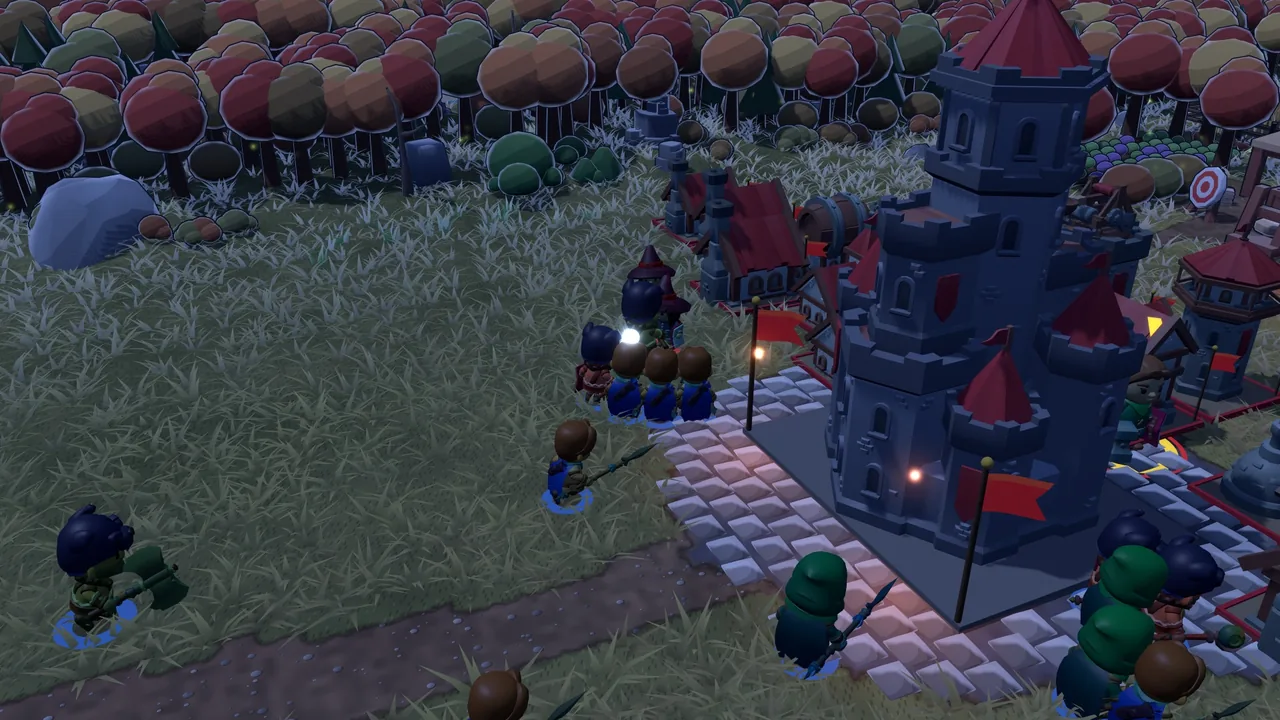
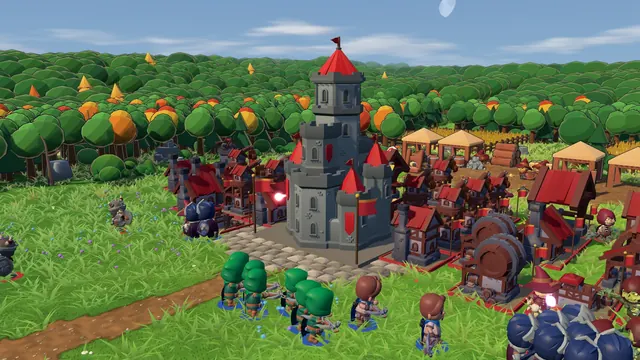
There was a day when we brought the camera down to the ground of the Autumn Crossroads. Between the two russet groves, leaves were falling, and the wind carried them across the trails. It was the first time we felt that the world was alive.
But it didn't start that way.
The first day's list
On the first day of Castle Arena we wrote a frank review of the visuals, and it wasn't pretty:
- With the camera zoomed out, troops were five to eight pixels tall.
- The team color lived in a thin ring on the ground. In a mirror match, you couldn't tell which side each soldier was on.
- The central forest hid the entire fight on the north lane.
- The smoke from a ruined castle looked like a pile of gray hexagons.
- And there was no sound at all.
Almost everything that came next was born as an answer to that list.
A sky that changes
The first step was to give the field a time of its own. A full day passes in 16 minutes of play, starting at a random hour. Night brings bluish moonlight, lanterns, torches on the castles and fireflies. The sky got a sun, stars, clouds drifting with the wind and a moon whose phase changes from match to match.
The weather also changes during the match: clear sky, cloudy, light rain, heavy rain with thunder, ground fog, and snow that piles up on roofs and treetops. A storm never arrives unannounced. About 20 seconds before, the HUD warns that it's coming, the wind picks up, and thunder rolls inside a dark wall on the horizon.

On top of that came the rare events: aurora borealis on clear or snowy nights (almost half the matches on Frozen Lake), a sandstorm sweeping through Dune Canyon, an eclipse that turns the afternoon into dusk for about 50 seconds, shooting stars, a rainbow after the rain and, at the Autumn Crossroads, leaves in the wind.
And then came the animals. Deer, rabbits, foxes, ducks and birds live at the edges of the field. They never set foot on it, but explosions and falling buildings send them running, and they come back when the dust settles. The ground keeps the marks too: the grass bends when troops pass, the busiest paths turn into packed dirt that becomes mud in the rain, and explosions leave scorched ground for a few minutes.
None of this touches the rules. The match draws its sky schedule from the same seed on both computers, so two online players see the same rain fall at the same moment.
Faces, walls and sound
This is where the work of the artists from the first chapter shows most. For a while, the armies looked like the draft they were: models in a single style. Then each faction got a face. Humans, elves, orcs and the undead got their own 3D buildings, and a building's level follows its upgrade path: the first step looks humble, the last looks proud. The Toon RTS packs brought undead, orcs, dwarves and barbarians, and twenty-two troops became real creatures, from bears and wolves to dragons and gargoyles.

But swapping a model is never just swapping a model.
Making a new model walk, fight and die is half the work.
Each pack comes with its own animations, and each model has to use the ones that came with it. A creature with no spawn animation, for example, has to simply start walking, instead of freezing for a moment as it leaves the building.
The buildings also started showing damage. Below 60% health they send up smoke, below 30% they catch fire, and the castle falls in flames. You can read a siege without looking at a single health bar.
And the field stopped being silent. A soundtrack came in, with battle tracks that take turns. Swords, bows and spells got their own sounds, gates creak, forests and seas have ambience, humans and monsters die with a voice, and the herald who warns that your castle is under attack now speaks.
The fog that was too pretty
Not everything that made the world prettier made the game better. The first fog of war in Castle Arena was made of clouds that covered the map and parted, forever, wherever your troops passed. It looked great. But once an area had been explored, it stayed open forever and said nothing about what was happening there now.
We swapped the clouds for a dark veil, like in the classic RTS games. What you have never seen stays in darkness. What you've explored stays in dimness, with the terrain and buildings you remember. And only what your troops can see right now is clear, with enemies visible. When a troop dies, the area around it goes back to dimness.

A field three times larger
The last step was the ground itself. The playable field went from 96 × 27 to 160 × 47, almost three times the area, and the arenas were redrawn from scratch, with paved roads, dense woods, lakes, fords, terraces and landmarks in the background, such as temples and mossy monoliths. Along with it came a new rule: no troop walks through a piece of scenery. If it looks solid, it is solid.
Until then, each arena was drawn by hand, in code. To stop that, we made a map editor, with the plan and the 3D scenery in the same window. The first arena made entirely in it was Moss River, the 15th: the bases on top of two plateaus, and the battle running down the ramps into a valley of dense forest, cut by a river with two bridges.

The secret sauce is still missing
Going back to the first day's list:
| On the first day | Now |
|---|---|
| Armies in a single style | Their own 3D models and buildings per race, each faction with its own tint |
| Impossible to tell which side each soldier was on | Clothes in the faction's color, and six team color palettes, with options for color blindness |
| Smoke like a pile of hexagons | Textured smoke, fire and sparks, and buildings that collapse into rubble |
| No sound | Soundtrack, weapon sounds, ambience, voices and a herald who speaks |
The world is more alive. You can see it in the details: the leaves, the mud, the animal that runs from an explosion.
But the secret sauce is still missing.
It's hard to say exactly what it is. Maybe it's the thing that makes you stop in the middle of a match just to look, and we know we haven't gotten there yet. While we were searching, another problem was growing quietly, and it had nothing to do with the visuals. It had to do with the numbers.
— The team