
A Rule That Fits in One Sentence

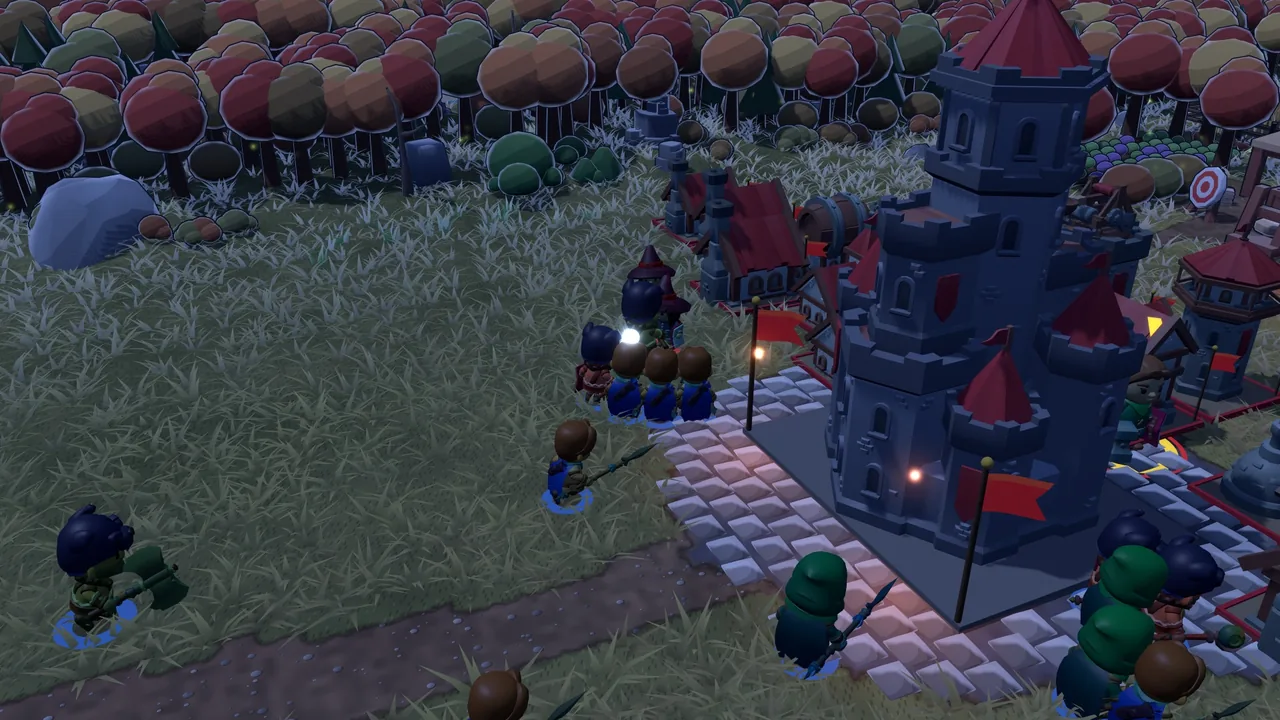
In almost every strategy game, your hand is on everything: you choose who attacks, who retreats, who holds the bridge. In Castle Arena, no. The central rule fits in one sentence: you never command a single soldier.
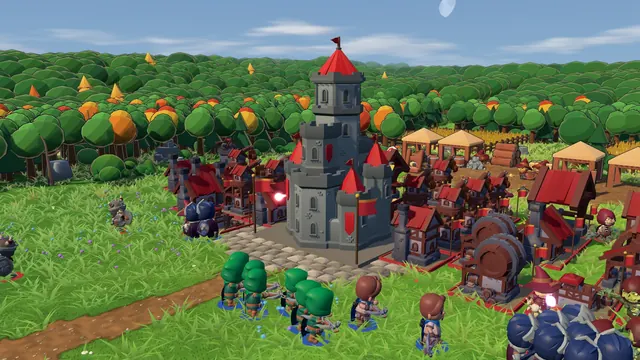
You raise buildings, the buildings train troops on their own, and the troops march down the two lanes around the woods in the middle of the field, facing whatever shows up. Your job is to decide what to build, where, and when.
The rule isn't ours
The previous chapter produced a list of Warcraft III maps, and the first one to become a game was Castle Fight. The rule came from it. Our job wasn't to invent it. It was to understand why it works and make it work again, faithful to the original's rules and numbers, in a game of its own for Steam.
And understanding it brought up the project's first hard question.
If the player doesn't command anyone, what do they do?
One match, from start to finish
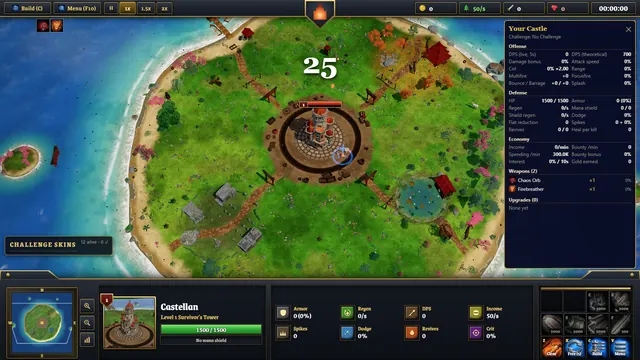
Each side has a castle, a territory to build in and a worker. The worker is your only unit: it walks only inside your territory, can't be attacked and raises every building. Each building has its own training cycle, and when its bar fills, a troop is born and heads for the enemy castle on its own.
Every troop has an attack type and an armor type, in a triangle you can read: Normal beats Medium, Pierce beats Light, Magic beats Heavy. You don't choose who the troop attacks, but you choose which troops will exist.
There are two ways to win: bring down the enemy castle, or reach the time limit (30 minutes by default) with more Rescues saved, a card that deserves its own section further down.
The answer is gold
Since you never guide a soldier, gold becomes your way of playing. Every building is a bet, and the economy was designed so those bets keep paying, or keep costing, for the whole match.
In the first version, every 7 seconds both players were paid. The castle gave 14 gold, and each building added a share of what it cost: 2% for troop buildings, 1.8% for siege, 1.2% or 0.9% for specials and 0.4% for towers. Income alone already had six different numbers. That's what the blank canvas is made of: hundreds of small decisions, each one affecting the others.

A tax so nobody pulls away
Without a brake, whoever gets ahead in the economy just keeps pulling away. So income is taxed in brackets of 25: the first bracket passes through whole, and each following bracket pays 10% more than the one before, up to 80%.
| Gross income | Net | You keep |
|---|---|---|
| 30 | 29.5 | 98% |
| 100 | 85 | 85% |
| 260 | 142 | 55% |
Those who earn little barely feel it. Those who earn a lot lose almost half. Between two players who invest everything, income ends up similar, and the weight of the match goes back to what you build, not just how much.
Idle gold is a mistake
To make sure the economy rewards those who invest, we ran a test: 1,000 gold in hand, against an enemy that was already producing.
- Investing in troop buildings: won 6 of 6 matches.
- Saving the gold: won 1 of 6.
- Opening with War Drums or with two towers: lost every time.
Six matches is not enough to set a law, but the gap was too big to ignore. War Drums (650 gold, +33% damage for all your troops) aren't a bad item. Buying them in the first minute is the classic trap for beginners.
One big button
And then there is the Rescue, the match's single card. You get one, and it kills every enemy troop in a large area.
On a huge wave at your castle gates, one Rescue can be worth ten kills. Spent early, about two.
If it hits no one, it comes back after 3 minutes. And since at the time limit the side with more saved Rescues wins, it also works as a tiebreaker: whoever already spent their emergency button is usually the one who falls next.
What we didn't know yet
On paper, the design held together: decisions instead of clicks, gold that works, counters you can read, one big button for the right moment. What we didn't know yet was that these numbers wouldn't survive thousands of matches. Measured against other games of the genre, the economy ran three to four times richer than it should.
That story comes later. Before it, the field had to stop being an empty plan and become a place.
— The team